Guns Over Butter: Inside Trump’s $1.5 Trillion Defense Budget and How It Could Affect the Economy
On April 3, 2026, President Trump submitted his 2027 federal budget proposal to Congress, with the headline number being the $1.5 trillion defense budget. That figure, a 42% increase from the current defense budget, would represent the largest year-to-year jump in military spending since the end of World War II {¹}. Now, Congress has to weigh in on the budget, with Congressional committees passing appropriation bills before the new fiscal year. Let’s dive deeper into the numbers of this fiscal policy.
Although all $1.5 trillion of the defense budget is unlikely to pass, military spending will most likely increase. With the defense budget increasing, other programs are bound to get cut; here is what it could mean for the economy.
The new budget request specifically proposes $1.1 trillion through the standard appropriations process and an additional $350 billion through budget reconciliation, a legislative tool that allows the majority party to pass spending legislation without bipartisan support {²}. This $1.5 trillion budget proposal is an increase over the current $1.05 trillion total defense budget.
The administration claims the total is a necessary investment to strengthen the US military amid current global tensions. With the proposal including $65.8 billion for 18 new battleships and a $17.5 billion allocation for a space-based missile defense system, the administration argues that the increased spending is justified by active conflict with Iran and growing threats from Russia and China {³}.
So, what would get cut to afford this budget? Historically, this same situation has happened before, notably during the Vietnam War, when President Lyndon Johnson had to cut his domestic program funding in order to fund the military operations in Vietnam. President Trump is doing something similar. To partially offset the defense increase of $500 billion, the budget proposes reducing non-defense spending by 10%, which is roughly $73 billion {⁴}. These cuts span a wide range of domestic programs, all of which could cause a holdup in Congress, as seen in previous budget disagreements that led to a 43-day government shutdown, and could put more financial burden on consumers. To name a few, the Department of Health and Human Services faces a 12.3% reduction, including a $5 to $6 billion cut to the National Institutes of Health (NIH); the Department of Housing and Urban Development would see a 13% reduction {⁵} {⁶}; the EPA budget would be cut in half, and $775 million in food assistance grants would be eliminated {¹⁰}.
It’s not necessarily that the administration wants to completely get rid of these programs; it’s that the administration feels that many of these responsibilities should and can be managed more effectively at the state and local levels rather than the federal level. President Trump voiced this position at a White House event in April, saying, “We’re fighting wars. We can’t take care of day care. It’s not possible for us to take care of day care, Medicaid, Medicare – all these individual things. They can do it on a state basis.” {⁷}
One of the most consequential aspects of this budget proposal is its impact on the federal debt. Americans have been growing increasingly concerned as the federal debt grows without a halt in sight. The US is accumulating nearly $2 trillion in annual deficits, with the total national debt around $39 trillion {⁷}.
The Committee for a Responsible Federal Budget, a nonpartisan fiscal oversight body, estimates that Trump’s $1.5 trillion defense proposal would add approximately $5.8 trillion to the national debt over time {⁸}. Even with the $73 billion in domestic cuts, which is controversial on its own, the proposed budget would produce $2.2 trillion in deficit in 2027 alone, which is around $400 billion higher than 2026’s deficit, and $17.5 trillion in deficits over the next decade (assuming a 3% annual GDP growth) {⁹}. Simply put, there is not enough of the existing budget to cover the proposed increase in defense spending.
Three outcomes could result if the proposal is passed: the US could keep on taking on more and more debt through annual deficits, the administration could cut more programs to free up budget space, or the administration could generate revenue to pay for it through taxes (which is very unlikely under the current administration). No matter the outcome, there will be plenty of Americans frustrated.
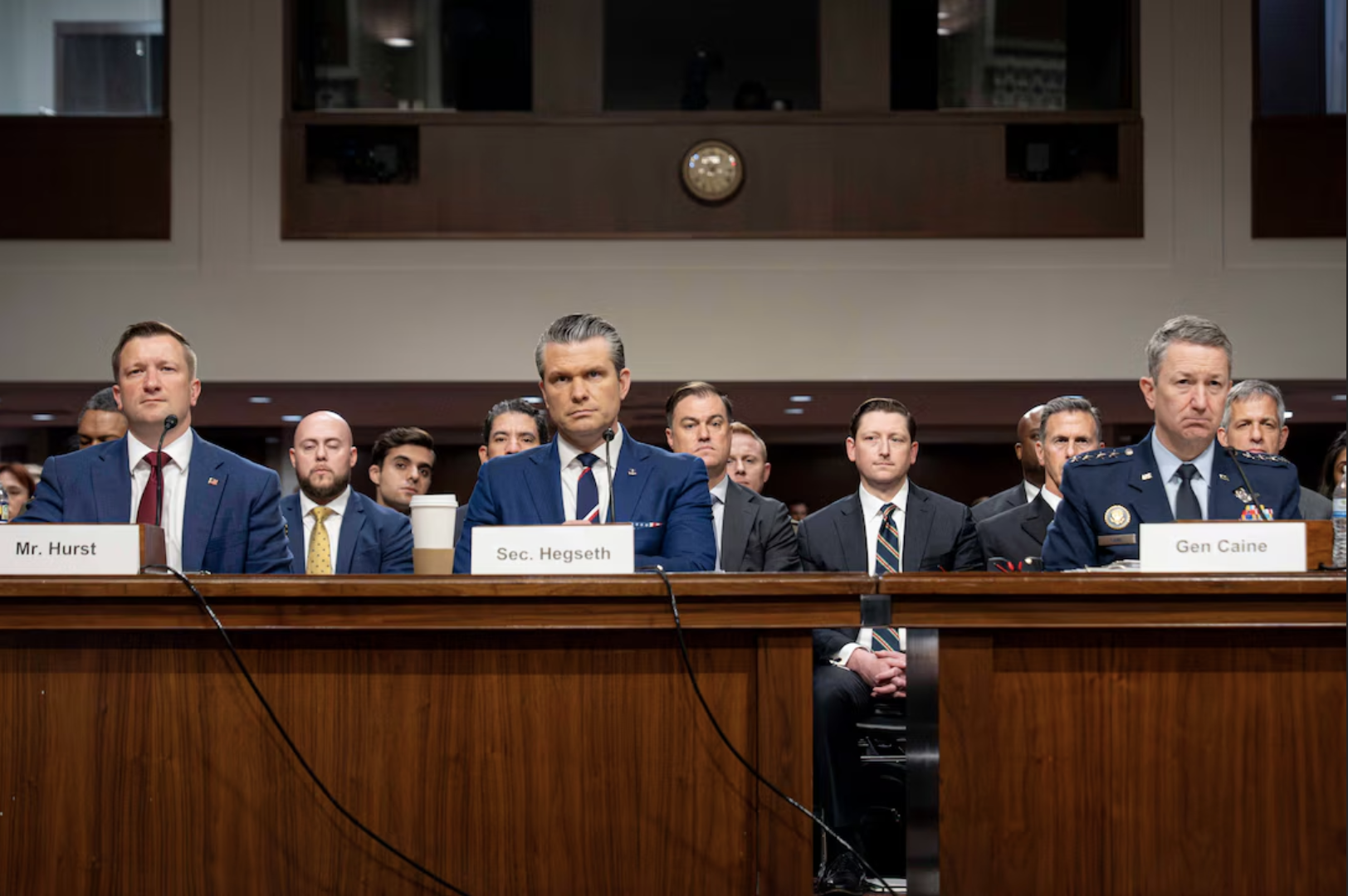
However, it is important to note that this is merely a proposed budget and is far from the final appropriated budget. Congress controls appropriations, and as of mid-May, the 2027 budget remains far from complete. There is strong opposition within the Democratic party and division within the Republican party over the budget, particularly regarding the defense increase and its repercussions. Recently, Defense Secretary Pete Hegseth appeared before Congress to defend the proposed budget and the mounting costs of the Iran war.
Moving forward, the 2027 appropriations process will run through the fall. Congress rarely passes the president’s proposed budget. Additionally, the outcome of November’s midterm elections, in which Democrats are expected to make significant gains, could significantly shape the final form of 2027 fiscal policy.
There are a few things for certain. This budget represents a significant shift in federal priorities. The president is choosing defense spending over domestic spending, but this requires the rest of Washington to agree. Whether this shift is the right one, and how much of this shift ultimately becomes law, will be something to keep your eye on in the coming months. President Trump is choosing guns over butter, but will Congress and the American people agree?
